
Your Ads Are Bringing in Sales.
Are They Making You Money?
A business owner on Reddit asked when it becomes safe to spend more on advertising. The answer begins with a number that most ad dashboards don't show you.
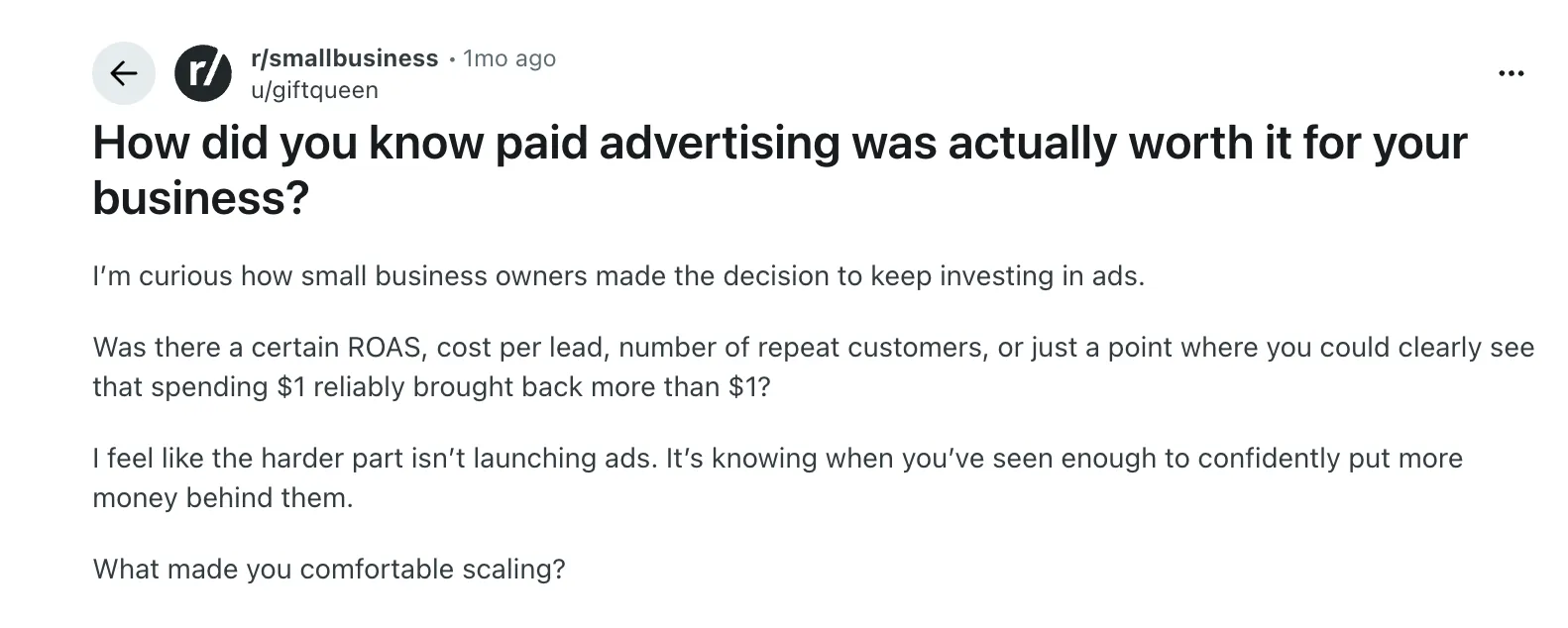
We recently came across a question on Reddit's r/smallbusiness community that gets to the heart of one of the hardest decisions in advertising: when do you know your ads are working well enough to justify spending more?
The business owner wasn't asking how to launch a campaign. They wanted to know what made other owners comfortable increasing their budgets. Was it return on ad spend (ROAS), cost per lead, repeat purchases, or simply seeing that the money going out was reliably bringing more money back in?
It's a sensible question, because an advertising dashboard can show a growing number of purchases while your bank balance tells a very different story. Before a business spends more, it needs to know whether those purchases leave enough money behind to cover the cost of acquiring them.
The number that matters isn't always ROAS
ROAS measures the revenue attributed to advertising divided by what was spent on the ads. It's useful for understanding campaign efficiency, but it does not tell you whether the business made a profit, because revenue is not the same as money left after costs.
$2,000 in attributed revenue ÷ $500 in ads = 4× ROAS
A 4× ROAS might sound reassuring. But what if fulfilling those orders costs most of the revenue? Two businesses can report the same ROAS and reach completely different conclusions about whether the campaign is worth continuing.
Same ad results. Two very different businesses.
Consider two hypothetical businesses that each spend $500 and attribute $2,000 in sales to their ads. Both report 4× ROAS. The difference is what remains after the variable costs of delivering those orders.
| Illustrative 30-day results | Business A | Business B |
|---|---|---|
| Attributed revenue | $2,000 | $2,000 |
| Advertising spend | $500 | $500 |
| ROAS | 4× | 4× |
| Variable product / delivery costs | $900 | $1,700 |
| Contribution before advertising | $1,100 | $300 |
| Contribution after advertising | +$600 | −$200 |
These figures are hypothetical and assume the attributed revenue represents genuinely additional orders. In real campaigns, some of those customers might have purchased anyway, so incrementality also needs to be considered.
Start with your break-even customer acquisition cost
If your business knows what a new customer contributes after the direct costs of serving them, you have a starting point for deciding how much you can afford to spend acquiring that customer. For a business relying on first purchases to pay for advertising, that contribution becomes the approximate break-even acquisition cost.
$500 in ads ÷ 25 new customers = $20 CAC
Now imagine the first purchase from each new customer leaves $28 after variable costs. With a $20 CAC, that leaves $8 of contribution after advertising per new customer, before fixed overheads and other costs. That may be acceptable for one business and inadequate for another.
$28 contribution − $20 CAC = $8 headroom
When a business depends on repeat purchases to justify acquisition costs, it also needs reliable evidence of how often customers return, how much they contribute over time, and how long it takes to recover the initial advertising expense. A projected lifetime value isn't cash in the bank today.
Five practical checks before increasing your ad budget
Check real orders, not just reported conversions
Compare ad-platform reports with your payment records, CRM, or order system. Check cancellations, refunds, duplicate conversions, and whether the same purchase may be credited to more than one channel. A dashboard is a useful signal, not a substitute for your actual sales records.
Calculate your contribution per sale
Include product costs, delivery subsidies, transaction fees, returns, and variable labour where relevant. Decide what acquisition cost your margins can support before you increase spending, rather than choosing a ROAS target simply because it sounds impressive.
Separate first-time customers from returning ones
Repeat customers are valuable, but a campaign that mainly claims credit for people who already planned to buy may not be generating much new business. Where feasible, use geographic tests, holdouts, or other controlled comparisons to estimate incremental sales.
Watch how long your money takes to come back
A business may eventually earn more than it spends acquiring customers and still struggle to pay suppliers next month. Compare the expected payback period with your cash reserves, stock commitments, and normal purchasing cycle.
Increase spending in controlled steps
Don't assume doubling the budget will double the sales. Make a measured increase, keep other major variables reasonably stable, and monitor the additional cost of each incremental customer. If acquisition becomes more expensive or fulfilment suffers, pause and reassess.
Why the next $500 may behave differently from the first
Advertising performance isn't fixed. Your earliest spend may reach people most likely to buy, while additional budget can extend into less responsive audiences or more expensive auctions. This means the average cost per customer from your first campaign may not describe what the next increase will deliver.
If your first-order break-even CAC is $28, the first customer group in this example may be viable while the later groups would require other economics, such as verified repeat-purchase contribution, to justify their cost.
A decision table you can use before scaling
| Question | What to check | Potential warning sign |
|---|---|---|
| Are we acquiring customers profitably? | CAC versus contribution after variable costs | CAC exceeds affordable threshold |
| Are these sales genuinely additional? | Incrementality and reconciled order data | Attributed conversions rise without total sales growth |
| Can we afford the payback period? | Cash flow and observed repeat purchases | Acquisition costs come due before cash returns |
| Can the business fulfil more demand? | Stock, staffing, service, refunds | Service quality deteriorates as volume rises |
| Does extra spend still work? | Marginal CAC after a controlled increase | New customers cost more than the ceiling |
Where advertising intelligence fits in
Small business owners shouldn't have to piece together every decision from disconnected dashboards and spreadsheets. At 4XDigital AI, we're building advertising intelligence around the context of the business itself: what it sells, who it serves, what it wants to achieve, and what its previous campaigns have taught us.
Our Business Memory is designed to retain that context alongside campaign settings, performance, and decisions, while Collective Intelligence helps inform decisions using patterns and learnings across businesses and campaigns. Together with our AI agents for strategy, creative, launching, and monitoring, this approach aims to make campaign management more informed across Meta, Google, and TikTok.
But no platform can replace accurate margins, real sales records, or a business owner's judgement about cash flow. Advertising intelligence should help owners ask better questions and interpret performance more clearly, not promise that every increase in budget will pay off.
The best reason to scale isn't a beautiful dashboard
The Reddit question deserves a more useful answer than a universal ROAS benchmark. You become more confident about increasing advertising spend when you can reconcile campaign results with real orders, understand the contribution each new customer makes, afford the time it takes to recover your investment, and see that additional spend continues to generate worthwhile business.
Sometimes those checks will tell you to scale. Sometimes they'll tell you to improve your offer, measurement, or margins first. And sometimes the most responsible decision is to leave the budget exactly where it is.
The point of advertising isn't to spend more confidently. It's to know when spending more actually makes sense.
Make advertising decisions around your business.
4XDigital AI brings business context and advertising intelligence together to help you create, launch, monitor, and improve campaigns across Meta, Google, and TikTok.
Explore 4XDigital AI ↗Source: r/smallbusiness discussion, “How did you know paid advertising was actually worth it for your business?” Financial examples and charts are hypothetical and are not reported campaign results.


