
Cross Channel Analytics Tools Are Useful. But Only If They Help You Understand What Is Actually Happening.
For ecommerce teams running campaigns across several channels, the challenge is not collecting more numbers. It is seeing enough of the customer journey to make a better decision about what happens next.
Most ecommerce brands do not have a shortage of data.
Google has one version of the story. Meta has another. Email has its own reporting. The website tells you what people did once they arrived. Somewhere in the middle of all of that is the actual customer journey.
That is what makes cross channel analytics useful. The point is not to track every possible movement simply because the technology allows it. The point is to understand how the different parts of the marketing effort are working together.
A customer might discover a product through Instagram, come back through Google a few days later, open an email and finally purchase. If each channel is viewed completely on its own, the business can end up making decisions based on only one part of that journey.
The right analytics tool helps connect more of those dots. The better question is which tool fits the problem the business actually needs to solve.
A strong place to understand what people do across your site and app
GA4 is often the obvious starting point because it is already part of the Google ecosystem and gives ecommerce businesses a detailed view of how people move through websites and apps.
That makes it useful when the business wants to understand things such as where visitors came from, what they did after arriving, which events happened before purchase and where people tend to disappear from the journey.
The advantage is not simply that GA4 collects a lot of information. It is that it can help connect acquisition activity with the behavior that follows. For a business already using Google Ads, that integration can make the relationship between advertising and onsite behavior easier to investigate.
The tradeoff is that GA4 can still feel like a lot. A dashboard full of events and attribution information does not automatically tell a small team which decision deserves attention first. It works best when the business has a clear idea of what it is trying to understand.
Better suited to teams that want to go deeper into customer behavior
Mixpanel becomes more interesting when the question moves beyond where traffic came from and toward how people actually behave inside the product or website.
For an ecommerce team, that could mean looking at the sequence of actions people take before purchase, identifying where a funnel loses customers or comparing the behavior of different groups over time.
Its cohort and funnel analysis can be valuable when a business wants to understand more than the first transaction. A customer who purchases once and disappears tells a different story from somebody who returns several times, and that difference matters when the goal is profitable growth rather than simply producing more conversions this week.
As with any detailed analytics platform, the value depends on implementation. Tracking everything without knowing why you are tracking it can still leave the team with more information than clarity.
Useful when the harder problem is not seeing the data, but deciding what to do with it
There is a point where another reporting layer is not really what the team needs. The numbers are already there. The difficult part is understanding whether a change matters and what should happen because of it.
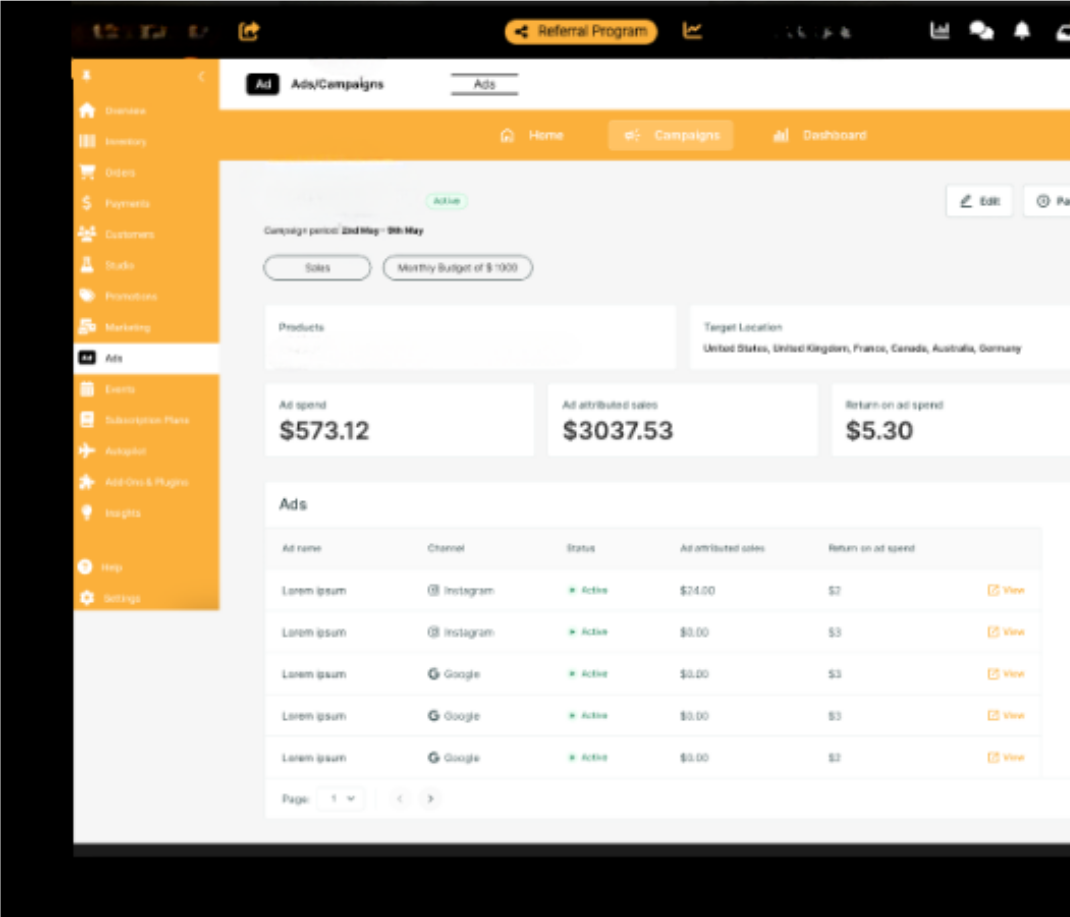
That is the gap 4XDigital is designed around.
Rather than treating Google, Meta and other campaign activity as completely separate histories, 4XDigital brings more context into the decision. Business Memory carries forward what the business has already learned from previous campaigns. Collective Intelligence helps place those results alongside patterns seen across similar businesses without exposing individual business data. AI helps interpret the signals that may deserve attention.
For a smaller ecommerce team, that matters because the question is often not “What was the click through rate?” It is “Is this performance change important enough to act on, and what should we change?”
Most useful when marketing analytics needs to sit closer to the CRM
HubSpot makes the most sense when the business is not only trying to understand campaign performance but also wants that information connected to the customer relationship.
Its strength is that marketing activity can sit alongside CRM information, lifecycle stages and customer history. That can make it easier to understand what happened before a lead or customer converted and what happened after.
For ecommerce businesses with more complicated customer journeys or teams already working heavily inside HubSpot, that connection can be valuable. It can also become more platform than a smaller business needs if the immediate problem is simply understanding paid advertising performance.
That is why choosing an analytics tool should start with the question the team needs answered, not with the longest feature list.
Start with the question your team keeps struggling to answer.
GA4 is a sensible place to begin, particularly when Google Ads is already an important part of the acquisition mix.
Mixpanel gives teams a deeper way to explore how different customer groups behave and where people drop out of the journey.
HubSpot makes more sense when marketing performance needs to connect closely with customer history and lifecycle activity.
4XDigital is built around turning cross channel advertising signals into more useful decisions, particularly for smaller teams that do not have specialists sitting behind every dashboard.
More data is only useful when it reduces uncertainty.
Cross channel analytics is valuable because customers do not experience a business one platform at a time. Their journey moves across search, social, email, websites and repeat visits.
The tool should help the team understand that journey without making the work around it more complicated than the marketing itself.
For a smaller ecommerce business, the best analytics setup is not necessarily the one that can track the most. It is the one that helps the team see enough of what matters to make the next decision with more confidence.
See the signals. Understand what they mean.
4XDigital helps businesses create, launch, monitor, understand and improve advertising across channels with more context behind every decision.
.svg)

