
You Have $2 a Day for Ads. Should You Even Run Them?
A café owner on Reddit asked whether $1–$2 a day could make a difference. Before spending a dollar, here are the free fixes, practical hacks and numbers worth checking.
A tiny ad budget is not a growth strategy by itself.
Free visibility first. Paid tests later.We came across a post on Reddit’s r/smallbusiness community from someone running a small café. Business was going okay, but they felt almost invisible online. They had no real Instagram presence, couldn’t afford to hire a marketer and weren’t happy with the posters they had tried making in Canva. Their question was whether Meta ads at $1–$2 a day were worth trying.
We understand why they asked. When you’re buying ingredients, covering rent and making payroll, even $60 a month is money you have to think about. And when marketing advice online seems to assume you have a designer, an agency and a comfortable testing budget, it can feel as though the advice was written for someone else entirely.
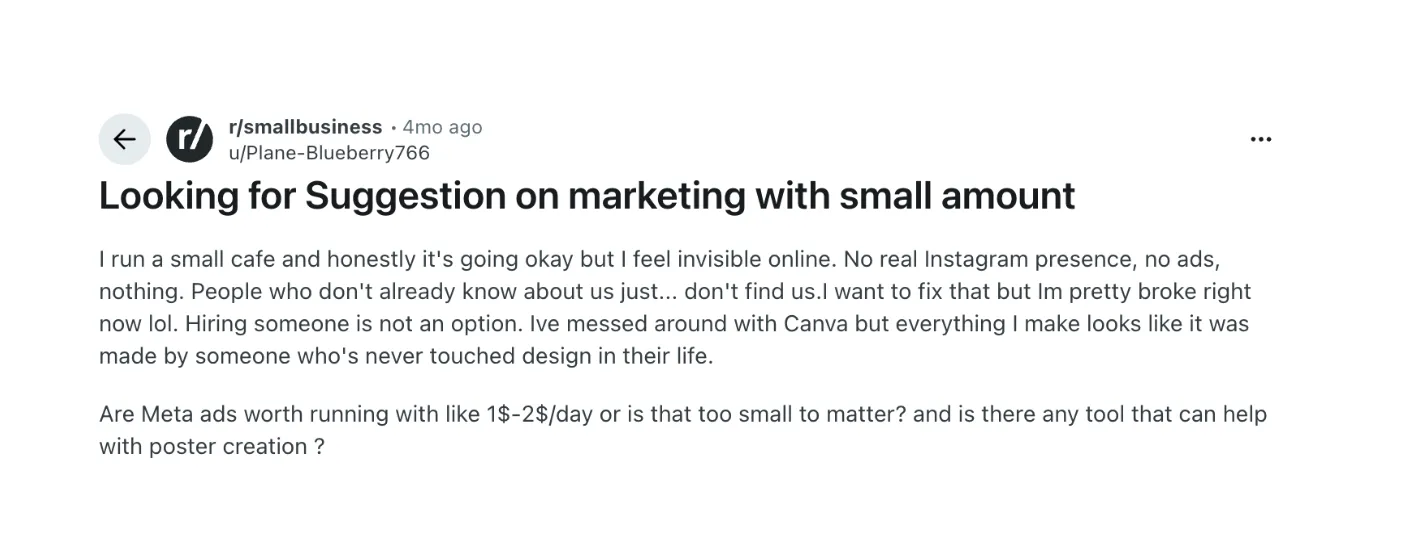
Our answer: we wouldn't start with the ads
At $2 a day, the budget comes to about $60 over 30 days. That may buy some exposure, but it doesn't guarantee meaningful reach, a steady stream of customers or enough conversion data to tell you what worked. Platform minimums, auction costs and delivery constraints also vary by campaign setup. If $60 is money the owner cannot comfortably lose, we wouldn't advise spending it on a speculative test.
Instead, we'd spend the first couple of weeks making the café easier to find, easier to trust and easier to choose. Most of that work costs time rather than media spend, and it remains useful even if the business never runs an ad.
Where should the next marketing hour go?
| What you see | What to do first | Why |
|---|---|---|
| Missing or outdated Google listing | Fix your Business Profile | People actively searching nearby need accurate information. |
| No recent photos or clear menu | Take five useful phone photos | Help people decide before they visit. |
| Customers love you but rarely review | Ask for honest reviews | Make existing customer satisfaction visible. |
| All basics in place, clear offer, spare budget | Consider a small, measured ad test | Now there's something useful for the ad to point to. |
Seven marketing hacks we'd actually try at a neighbourhood café
1. Treat Google Maps like your digital front door
Claim or update your free Google Business Profile, confirm the address and opening hours, add a current menu link and upload photographs of the entrance, seating and best-selling items. Search for the café as though you were a first-time customer and fix anything that would make visiting inconvenient.
2. Take photos when the food looks its best, not when the café is empty
You don't need a studio shoot to show a good croissant or a welcoming counter. Use window light, wipe the lens, take one close-up and one wider photo, and avoid making every post look like a promotional poster. Real images help people imagine being there.
3. Ask for reviews without making it awkward
Put a small QR code near the till linking to your Google review page and ask satisfied customers for an honest review. Don't offer discounts in exchange for positive ratings, write reviews on customers' behalf or pressure people to leave five stars. A handful of genuine, recent reviews can tell prospective visitors more than a polished slogan.
4. Give nearby people a reason to come in this week
Instead of a generic “visit us” post, try something specific and true, such as “Fresh cinnamon rolls from 8 AM on Fridays” or “Our weekday lunch special is available until 2 PM.” Only run a discount if the margin supports it. A useful message explains what, when and where without making the owner spend hours designing it.
5. Partner with one business on the same street
A café could collaborate with a nearby bookshop, salon or coworking space on a simple cross-promotion, such as sharing each other's posts or creating a joint local event. Ask permission, make the offer relevant to both audiences and start with something easy to execute rather than a complicated campaign.
6. Use a repeatable content routine, not a daily posting obligation
Set aside 30 minutes once a week to capture a few photographs and one short video. Share a popular product, a behind-the-scenes moment and a practical update such as a new menu item or opening-hour change. Consistency helps, but posting every day is not a requirement for running a good café.
7. Track one simple signal that happens in the real world
For a limited-time offer, use a distinct phrase at the counter, record redemptions and ask new customers how they heard about you. These methods are imperfect and won't prove that every sale was caused by a post, but they're more useful than treating likes as revenue. Keep a simple tally and look for patterns over several weeks.
What costs cash, and what mostly costs time?
| Activity | Media cost | Practical effort | Best used for |
|---|---|---|---|
| Google Business Profile updates | $0 | About 30–60 minutes to start | Local discoverability |
| Phone photos and short videos | $0 | About 30 minutes weekly | Showing the real experience |
| Review QR code and polite requests | $0 in ad spend | Setup plus small ongoing effort | Building trust |
| Neighbourhood collaboration | Potentially $0 | Coordination time | Relevant local exposure |
| Paid Meta test | Variable; $60 is not a guarantee | Setup, monitoring and measurement | Testing a clear offer once ready |
Effort estimates are illustrative, not platform promises. Printing, promotions and staff time may create additional costs.
The formula to use before you spend anything
Let's say the café wants to promote a breakfast that sells for $10. If ingredients, packaging and other variable costs come to $4, each additional breakfast contributes $6 before advertising and other fixed costs. This is a hypothetical teaching example, not data from the Reddit café.
Ten extra breakfasts is the break-even requirement, not a prediction that the campaign will deliver ten customers. It also assumes the café can serve those purchases without additional variable costs beyond the $4 estimate. Customers who would have bought breakfast anyway do not count as incremental sales generated by the campaign.
How many additional breakfasts would cover $60 in ad spend?
Bars show illustrative contribution from additional breakfast sales on a $90 scale. The $60 break-even point occurs at 10 extra breakfasts. These are not campaign results.
A $2 daily budget adds up, even before results are known
Spend illustration only; it does not imply that an advertising platform will spend exactly $2 every day or generate results in proportion to spend.
When would we actually test Meta ads?
Only after the café's basic online presence is in good shape, the owner has an offer with enough margin to support promotion, and the amount being tested is money they can afford not to recover. We'd choose one clear goal, use a sensible local audience where the platform permits it, and decide in advance how to measure interest and sales. We would also check the campaign's current minimum budget and delivery requirements before assuming that $1–$2 per day is a workable setup.
If the owner has no way to tell whether an ad brought in customers, spending more won't fix the measurement problem. And if the business is already struggling to cover essentials, our recommendation would be to keep the money and focus on free discoverability, repeat visits and local relationships first.
A realistic four-week plan
| Week | One achievable priority | What to check |
|---|---|---|
| 1 | Update Google listing, menu, photos and opening hours. | Can a stranger find the café and plan a visit? |
| 2 | Photograph three best-sellers and post useful updates. | Does the content show a clear reason to visit? |
| 3 | Ask for honest reviews and approach one local partner. | Are more people discovering or asking about the café? |
| 4 | Review enquiries, visits and offer redemptions; decide whether a paid test is affordable. | Is there evidence worth building on, or should the café keep improving the basics? |
Where advertising intelligence fits in
At 4XDigital AI, we believe that good advertising begins with understanding the business rather than simply launching campaigns. Our Business Memory approach is designed to bring together products, customers, goals and campaign learnings, while Collective Intelligence draws on relevant patterns to help inform decisions across campaigns and businesses.
That kind of context becomes more useful once a business is ready to advertise, because the question isn't just how to create an ad but which objective, message and audience make sense for that particular business. Our platform supports advertising across Meta, Google and TikTok, but it cannot make an unaffordable budget safe or guarantee a return. Sometimes the right marketing decision is to improve the basics before buying media.
The real win is knowing what to do next
What stayed with us about the Reddit post was how familiar the owner's situation felt. They weren't asking to build a national brand. They wanted people beyond their regulars to discover a café they had worked hard to create, without having to become a designer, media buyer and analyst in the process.
We'd tell that owner to make the café visible where local customers are already looking, show the experience honestly, give people a specific reason to visit and keep a simple record of what seems to help. If paid advertising becomes affordable later, they'll have a better foundation and a clearer way to judge whether the money is working.
Make advertising decisions around your business.
Explore how Business Memory, Collective Intelligence and AI agents support advertising strategy, creative, launching and monitoring across Meta, Google and TikTok.
Explore how it works ↗

